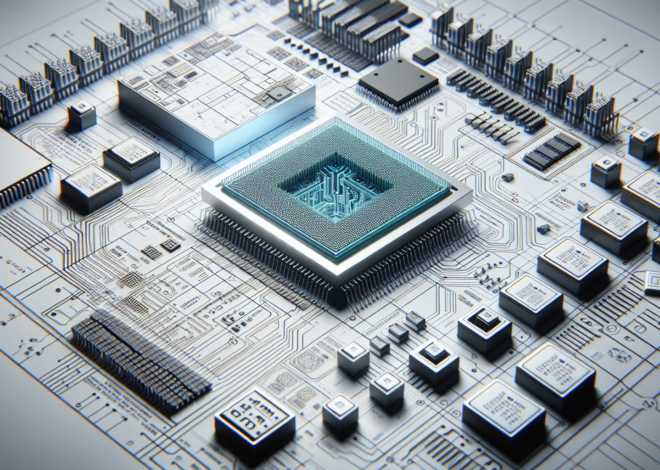
AI Chip Technology: Insights from Rebellions’ $400M Funding
“`html
AI chip technology refers to specialized hardware designed to accelerate artificial intelligence computations, particularly for inference tasks. Recent developments, such as AI chip startup Rebellions raising $400 million at a $2.3 billion valuation, highlight the growing competition in this space, particularly against established players like Nvidia. In this article, we will explore the significance of AI chip technology, its implications for developers, and what the future holds for this rapidly evolving field.
What Is AI Chip Technology?
AI chip technology refers to hardware specifically designed to optimize the processing of artificial intelligence applications, particularly for inference tasks. These chips enable faster and more efficient execution of AI models, enhancing their performance in real-time scenarios. With the recent funding round of Rebellions, a startup focused on AI inference chips, the importance of this technology in the AI landscape is more pronounced than ever.
Why This Matters Now
The competitive landscape for AI chip technology is intensifying as companies seek to reduce dependence on established players like Nvidia. The growing demand for efficient AI processing has made it crucial for developers to explore alternatives that can provide superior performance at lower costs. Rebellions’ recent funding and expansion plans signify a shift in the industry, encouraging innovation and competition. This is particularly relevant as industries increasingly adopt large language models (LLMs) for various applications, driving the need for robust AI infrastructure.
Technical Deep Dive
AI chips are typically categorized into two main types: training chips and inference chips. Training chips are optimized for the heavy computational tasks required to train AI models, while inference chips excel in executing pre-trained models efficiently. Rebellions focuses on the latter, providing products like RebelRack and RebelPOD, which are designed to scale AI deployments effectively.
Here’s a brief overview of the features of RebelRack and RebelPOD:
| Feature | RebelRack | RebelPOD |
|---|---|---|
| Purpose | Integrates multiple racks for scalable AI deployment | Production-ready unit for inference compute |
| Scalability | Designed for large-scale applications | Optimized for quick deployment |
| Use Case | Best for enterprise-level AI solutions | Ideal for startups and smaller projects |
In practical terms, developers can leverage these chips to enhance the performance of their AI applications. For instance, using the TensorFlow Lite framework, developers can deploy models optimized for inference on hardware like RebelPOD:
import tensorflow as tf

# Load a pre-trained model
model = tf.keras.models.load_model('my_model.h5')

# Convert the model to TensorFlow Lite
converter = tf.lite.TFLiteConverter.from_keras_model(model)
tflite_model = converter.convert()

# Save the model to a file
with open('model.tflite', 'wb') as f:
    f.write(tflite_model)
Real-World Applications
Healthcare
AI chips can empower healthcare applications by enabling faster analysis of medical images and patient data. For example, inference chips can quickly process MRI scans, aiding in timely diagnosis.
Finance
In the finance sector, AI chips enhance fraud detection systems by enabling real-time analysis of transactional data, thus improving security and operational efficiency.
Telecommunications
Telcos can utilize AI chips to optimize network performance, facilitating better management of data traffic and enhancing user experience through improved service delivery.
What This Means for Developers
Developers should start familiarizing themselves with AI chip technology, particularly inference chips, as they become integral to AI applications. Understanding how to optimize models for these chips can significantly enhance application performance. Additionally, developers should explore partnerships with companies like Rebellions to leverage cutting-edge technology that aligns with their projects.
💡 Pro Insight: As AI continues to be integrated into various sectors, the demand for efficient inference chips will only increase. Companies that adapt quickly and invest in the right technologies will gain a competitive advantage in their respective markets.
Future of AI Chip Technology (2025–2030)
Looking ahead, the AI chip market is poised for significant growth. By 2030, we can expect to see a diversification of chip architectures tailored for specific AI workloads, making it easier for developers to choose the right hardware for their applications. Moreover, advancements in AI chip fabrication techniques will likely lead to more energy-efficient designs, addressing the growing concern over power consumption in AI operations.
As companies like Rebellions continue to innovate, we may also witness a surge in collaborative efforts among tech giants and startups, leading to more robust AI ecosystems. This could result in more affordable solutions that democratize AI technology, allowing smaller companies to compete effectively.
Challenges & Limitations
Market Competition
The AI chip market is becoming increasingly saturated, with numerous startups vying for attention. While competition fosters innovation, it also makes it challenging for new entrants to establish themselves.
Technical Complexity
Developing and optimizing AI chips for specific applications requires deep technical expertise. Companies must invest in skilled personnel and R&D to keep pace with advancements.
Cost Implications
AI chips can be expensive to produce, and the initial investment may be a barrier for smaller companies. Balancing performance with cost efficiency is crucial for widespread adoption.
Key Takeaways
- AI chip technology is critical for optimizing artificial intelligence applications, especially for inference tasks.
- Rebellions’ recent funding highlights the rising competition against established giants like Nvidia.
- Understanding different AI chip architectures can significantly enhance application performance.
- Developers should explore partnerships with emerging chip manufacturers to leverage cutting-edge technology.
- The future of AI chip technology will likely involve more energy-efficient designs and tailored solutions for specific workloads.
Frequently Asked Questions
What are AI chips used for?
AI chips are primarily used to accelerate machine learning tasks, especially for inference, allowing AI models to respond quickly to user queries and process large amounts of data efficiently.
How do inference chips differ from training chips?
Inference chips are optimized for executing pre-trained AI models, focusing on efficiency and speed, whereas training chips are designed for the intensive computational tasks involved in training models from scratch.
Why is the AI chip market growing?
The AI chip market is expanding due to the increasing demand for AI applications across various industries, requiring more efficient and specialized hardware to handle complex computations.
For more insights on AI chip technology and the latest developments in the field, follow KnowLatest.